
 Fondofold-Bag
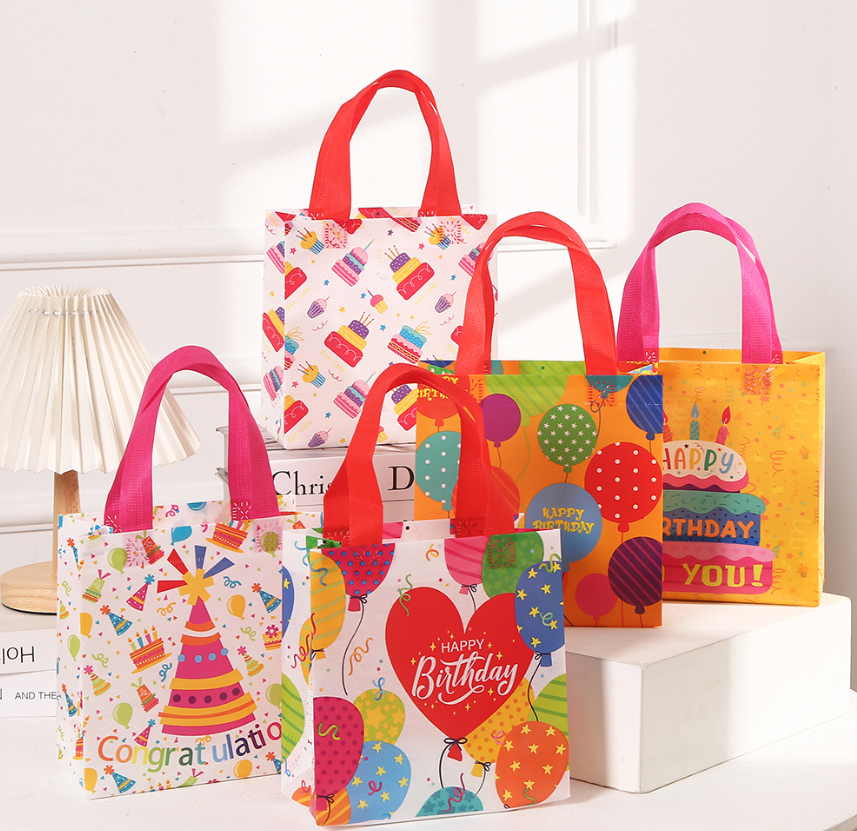
Non-woven fabric tote bags, as the name suggests, are tote bags made of non-woven fabric. They are an eco-friendly product, durable, aesthetically pleasing, breathable, reusable, washable, and can be screen-printed with advertisements and logos. They have a long lifespan and are suitable for any company or industry for advertising, promotional gifts, and outer packaging. Consumers receive a beautiful non-woven bag while shopping, and businesses gain intangible advertising benefits—a win-win situation. Therefore, non-woven fabric is becoming increasingly popular in the market.
The product uses non-woven fabric as its raw material, a new generation of environmentally friendly material. It features moisture resistance, breathability, flexibility, lightweight, non-combustibility, easy decomposition, non-toxicity, non-irritating properties, rich colors, low price, and recyclability. This material decomposes naturally outdoors in 90 days and has a lifespan of up to 5 years indoors. When burned, it is non-toxic, odorless, and leaves no residue, thus not polluting the environment. It is internationally recognized as an environmentally friendly product that protects the Earth's ecology.
Production Process
Non-woven bags are generally printed using screen printing, also known as "silk screen printing," which has long been a common printing process for many manufacturers. However, this process is usually done manually, making color control difficult. Therefore, many new non-woven bag printing methods have emerged. Here, we introduce some of the mainstream methods currently on the market:
However, as customers' demands for high-quality printing and environmental friendliness continue to increase, many new non-woven fabric printing methods have emerged. Here, we introduce some of the mainstream methods currently on the market:
I. Water-based Printing
Named for its use of water-based elastic ink as the printing medium, this method is common in textile printing and is also called printing. During printing, the ink and water-based elastic ink are mixed. No chemical solvents are needed when washing the printing plate; it can be rinsed directly with water. Its characteristics include good coloring power, strong hiding power and fastness, water resistance, and virtually no odor.
II. Gravure Printing
Finished products processed using this method are typically called laminated nonwoven bags. This process involves two steps: first, using traditional gravure printing to transfer the image onto a thin film; then, using a lamination process to attach the printed film to the nonwoven fabric. This process is generally used for nonwoven bags with large-area color printing. Its advantages include high-quality printing, fully machine-made production, and a short production cycle. Additionally, the product has excellent waterproof properties, and the finished product is more durable than nonwoven bags produced using other processes. The film is available in glossy and matte finishes, with the matte finish having a frosted effect. A disadvantage is that it conflicts with environmental protection concepts because the film is difficult to degrade.
III. Heat Transfer Printing
Heat transfer printing is a special type of printing. This method requires an intermediate medium: the image is first printed onto a heat transfer film or paper, and then the pattern is transferred to the nonwoven fabric using a heat transfer device. Heat transfer film is commonly used in textile printing. Its advantages include: high-quality printing, rich tonal range, and photographic quality. It is suitable for small-area color image printing. The disadvantages are the high price and high printing costs.


